What Families Who Have Done Everything Find on the Caribbean Coast of Costa Rica
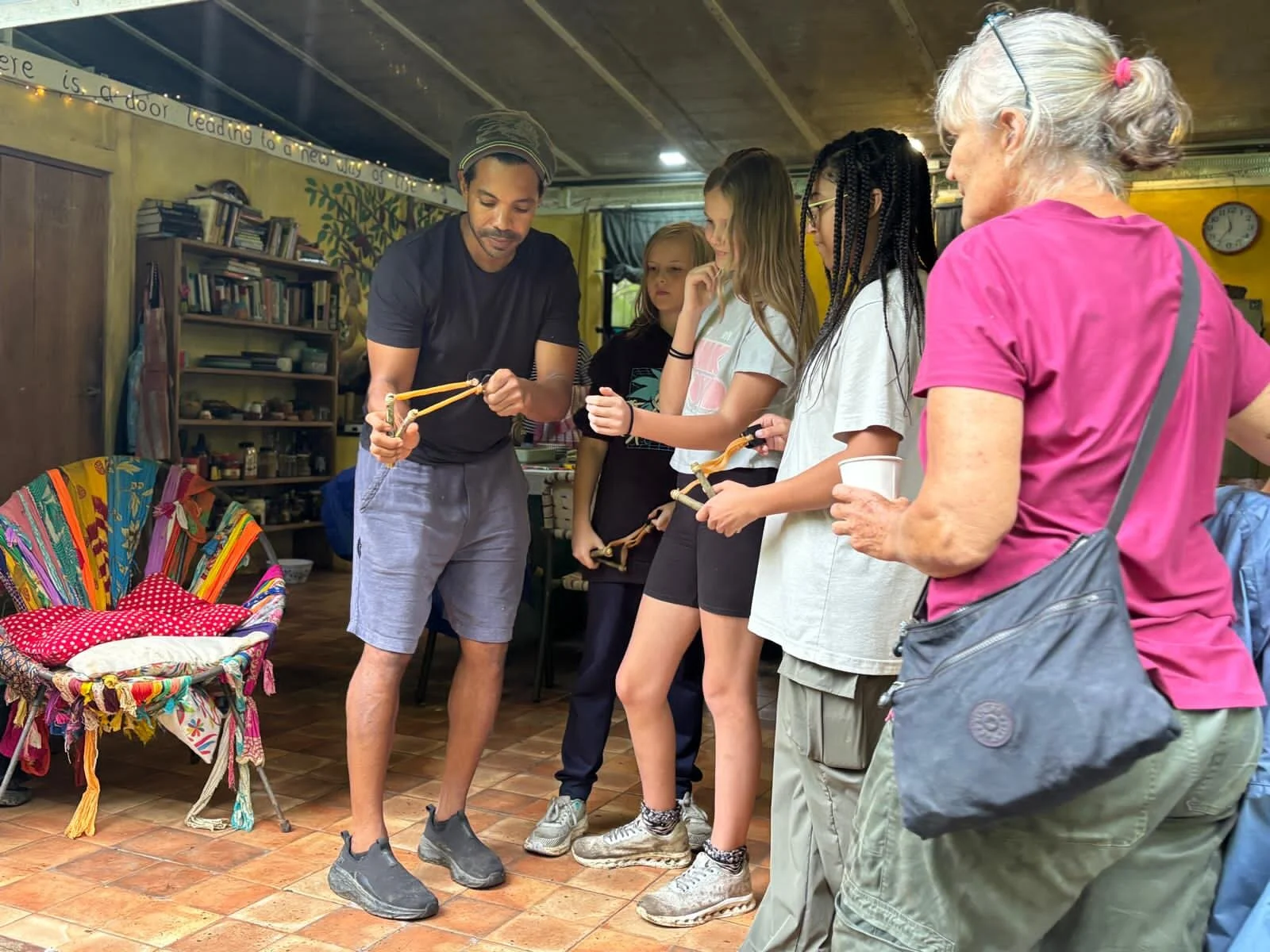
There is a particular kind of worldschooling family who finds their way to us.
They are not new to this. They have done the retreats, the pop-ups, the programmes in Bali and Portugal and Mexico. Their children have been in and out of alternative schools on three continents. They know the difference between an experience that is well-organised and one that is genuinely transformative.
They are not looking for logistics handled. They have done that. They are not looking for a curriculum that travels with them, a familiar framework applied to an unfamiliar backdrop. They have done that too.
They are looking for something that cannot be taken anywhere else. A place so specific, so rooted, so genuinely particular to itself that the learning is inseparable from the location. A place where the educators are not teachers who moved here for a season but people whose families have been here for generations. Where the culture is not a module but a life being lived beside you.
They are looking, in short, for the Caribbean coast of Costa Rica.
And they tend to find us when they get here.
What makes the Caribbean coast different from everywhere else
Most worldschooling programmes, however well designed, are ultimately portable. The curriculum, the community model, the educational philosophy can be picked up and placed in a new country. The backdrop changes. The experience essentially does not.
The Caribbean coast of Costa Rica cannot be replicated anywhere. Not because of what it looks like, though it is extraordinary but because of what has grown here over centuries and what still lives here now.
This is the ancestral territory of the BriBri Indigenous people, a community whose relationship to cacao, to the forest, to ceremony and to the land is not a cultural programme. It is a living reality, maintained through generations of deliberate transmission. Juanita does not teach about BriBri culture. She carries it. When she sits with children and tells ancestral stories, she is doing what her community has always done passing something on before it is lost. A child who has sat with her carries something home that no curriculum can replicate.
Alongside the Indigenous community, the Caribbean coast is home to an Afro-Caribbean community descended from Jamaican workers who came to build the railroad in the late nineteenth century. They built a cultur of food, of music, of language, of belonging, that exists nowhere else in the world. Vic's family has been on this coast for over a century. When he cooks with children, the recipe is not the point. The history embedded in the recipe is the point. The particular way a community expresses its identity through what it grows and what it makes and how it feeds people, this is what families who have been everywhere suddenly find themselves encountering for the first time in a way that feels genuinely new.
This is the difference. Not the location. The depth of what lives in the location.
What happens to children who have already seen everything
Worldschooled children who have travelled widely develop a kind of sophisticated nonchalance. They have been to the markets, the farms, the community visits. They know the shape of these experiences. They arrive already knowing what is expected of them and how to perform engagement.
What we watch happen on the Caribbean coast, consistently, across different ages and different family backgrounds, is that the usual performance stops being available.
You cannot perform engagement with Juanita's stories. Either you are listening or you are not, and she will know the difference. You cannot perform competence on a stone grinding table at the BriBri cacao farm, it is harder than it looks and the only way through is to actually do it. You cannot perform curiosity on a sloth tracking session when Olivia is asking you to record real data that will contribute to actual research, either you are doing real science or you are not.
The Caribbean coast asks something real of children. And children who have spent years being sophisticated about their experiences find that they cannot be sophisticated about this. It catches them genuinely. That, for families who have done everything, is the thing that is hardest to find and most worth seeking.
What happens to parents
For parents who have built a worldschooling life over years, the Caribbean coast offers something equally rare, the experience of not having to facilitate.
Most worldschooling parents are doing multiple things at once. Working remotely. Managing logistics. Facilitating their children's learning. Maintaining some version of their own sanity. The lifestyle is extraordinary but it is also exhausting in ways that the Instagram version of it rarely captures.
Roots & Rhythms exists for exactly this family. A drop-off programme for children aged 10 and above, 9am to 3pm, Monday to Friday, three weeks on the Caribbean coast. Lunch included every day. Maximum 12 children, led by educators who have lived here for decades.
Your child steps into something extraordinary. You have six hours.
Work. Actually work, with the particular focus that comes from not managing anyone in the background. Or walk the reef pools at Chino Beach. Or sit in a café where nobody needs anything from you. Or simply be somewhere beautiful without an itinerary.
Pick up at 3pm. Your child has things to tell you, real things, specific things, the kind of things that start conversations that go on through dinner and into the next day. Head to the beach together. The Caribbean coast's afternoon light is unlike anything on the Pacific side.
For parents who have spent years making the worldschooling life work, this rhythm — child thriving independently, parent actually resting, afternoons at the beach together — is not what they expected to find. It is exactly what they needed.
Why small groups change everything
Families who have been through larger worldschooling programmes — even exceptional ones — know the particular loneliness that can exist within a big cohort. The child who takes a few weeks to find their people. The parent who never quite cracks the social dynamic of a large group. The experience that is rich but somehow slightly impersonal.
Maximum 12.
That is the number at Cacao Coast Classroom. Not as a marketing position but as a practical commitment to what depth requires. In a group of twelve, doing genuinely challenging and meaningful things together over three weeks, every child is known. The friendships that form are not the transient connections of a large programme, they are the particular depth that comes from a small group doing hard things together.
Families who have done everything tend to understand this immediately. The ones who have experienced both tell us the small group is the thing they did not know they were looking for.
The relationships that make this possible
The experiences available through Cacao Coast Classroom, the BriBri farm visit, the sessions with Juanita, the work alongside Derek at his community outreach centre, are not available to families who arrive in Puerto Viejo independently, however resourceful and well-travelled they are.
These relationships took years to build. In some cases decades. Between us, Claire, Sam and Susanna we bring nearly 70 years of life on this coast. These are not partnerships built for a programme. The programme grew from partnerships that already existed.
Families who have done everything, who have been to many places and had many experiences, tend to recognise this immediately. They can tell the difference between a cultural experience arranged for visitors and one that exists because the people arranging it genuinely belong to the place they are sharing.
That difference is not something that can be explained in a paragraph. It is something that is felt in the first session and confirmed by the last day.
What the Caribbean coast offers that nowhere else does
For families who have worldschooled widely and want to understand what makes the Caribbean coast of Costa Rica distinct, here is the most honest summary we can offer.
Nowhere else in the world has this specific intersection of Indigenous BriBri culture and Afro-Caribbean community life, within a coastal rainforest ecosystem of this biodiversity, led by people who have spent their lives here and built real relationships across all of it.
That is not a marketing claim. It is a geographical and cultural fact. The Caribbean coast of Costa Rica, specifically this stretch of the Talamanca coas, is genuinely singular. Families who have been everywhere find something here they have not found elsewhere. Not because we have built an exceptional programme, though we have tried to, but because this place is exceptional and we happen to live in it.
Two programmes. This summer.
Seeds & Stories — July 26 to August 14 A full family immersion for children aged 7 and above. Parents participate every day alongside their children. 8:30am to 1pm, Monday to Friday. All costs included. Maximum 12.
For families who want to be in it together — who want the shared experience to become a reference point that their family returns to for years.
Roots & Rhythms — August 23 to September 11 A drop-off programme for children aged 10 and above. 9am to 3pm, Monday to Friday. Lunch included every day. Maximum 12.
For worldschooling and digital nomad families who want their children to have something extraordinary while they work, rest and explore the Caribbean coast independently.
Both programmes are led by educators who live here. Everything is unique, no session repeats across the two programmes. Children who join both encounter something genuinely fresh across six weeks.
Early bird pricing until May 15. Apply at cacaocoastcr.com.
You can read what our families say at trustpilot.com/review/cacaocoastcr.com
Cacao Coast Family Guide
This guide covers everything you need to know about our programmes
